Introduction: The Real Story Behind AI in Africa
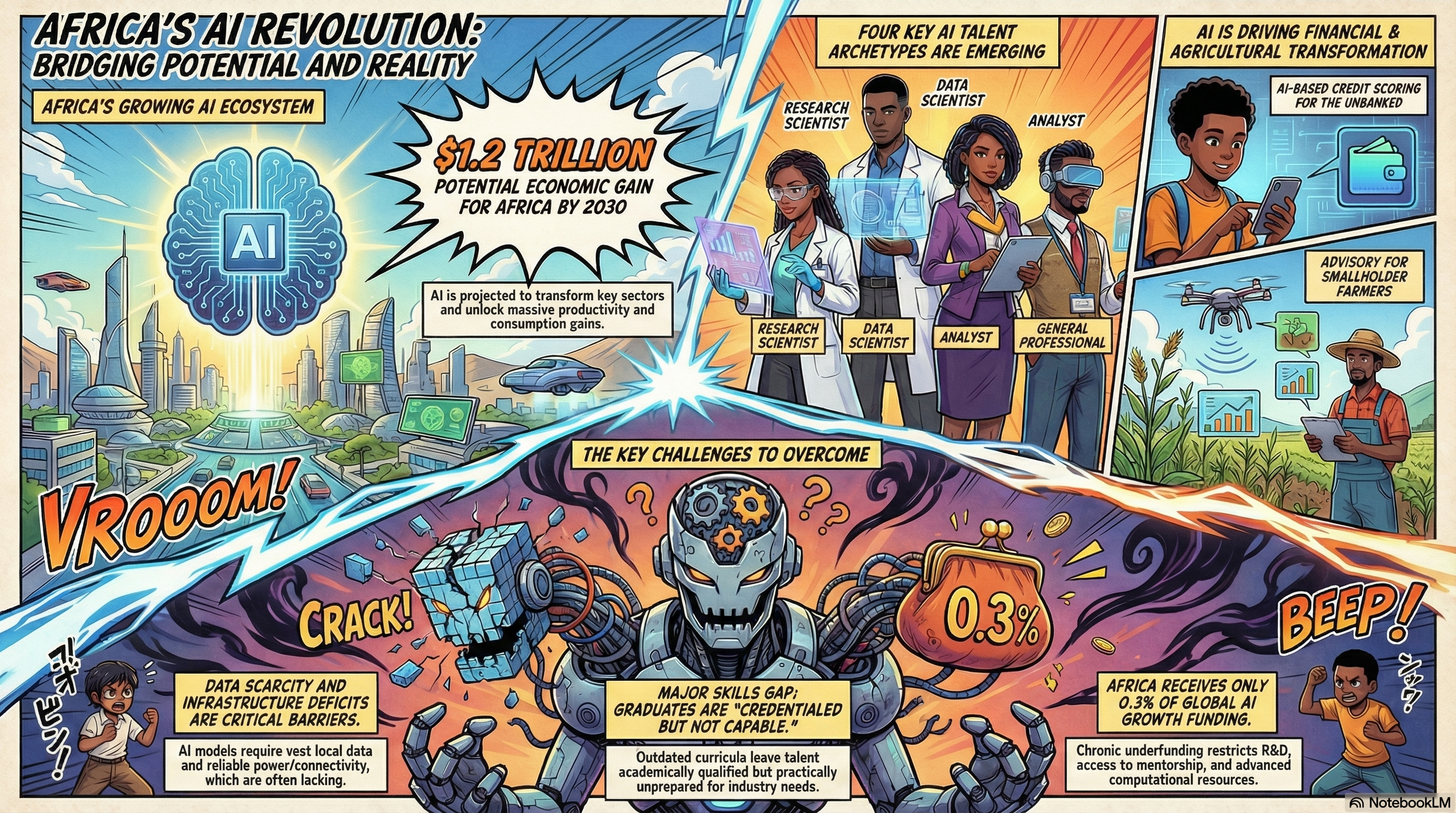
Artificial Intelligence is dominating global technology conversations, promising to reshape industries and economies. While the world focuses on AI superpowers, Africa—home to only 1% of the world’s AI talent and the source of just 0.12% of granted AI patents—is navigating a far more complex reality. The story of the continent’s AI journey is one of the most critical and misunderstood narratives in technology today, marked by incredible potential, grassroots innovation, and significant systemic hurdles.
Beyond the headlines of venture capital and mega-deals, a different kind of AI revolution is unfolding across the continent—one defined by practical solutions to unique, local challenges. But this progress exists within a complex ecosystem grappling with deep structural limitations. What is the reality of building a thriving AI ecosystem in Africa, and what stands between the continent’s immense talent pool and its technological future?
Takeaway 1: The AI Talent Gap Isn’t Just a Shortage—It’s a Structural Imbalance
On the surface, Africa faces a severe shortage of AI talent. A closer look, however, reveals a more surprising and complex structural imbalance in the continent’s educational pipeline.
While foundational AI skills training is expanding, there is a critical lack of advanced education required to produce high-level experts like “Research Scientists” and “Data Scientists.” PhD and specialized Master’s programs are not only limited in accessibility but also in quality; many are part-time and rarely aligned with cutting-edge AI advancements, constraining the development of industry-ready professionals.
Counter-intuitively, most development partner initiatives focus on training general users (non-technical professionals needing AI literacy for productivity) and analysts (who use basic machine learning tools). While valuable for broad digital literacy, this approach creates a “noticeable gap in the pipeline for high-end research and innovation competencies.” Without homegrown experts capable of advancing AI theory and building novel applications, Africa’s ability to produce its own AI innovations remains limited. This structural imbalance in education directly fuels the hyper-competitive job market, where employers must look beyond academic credentials to find truly capable talent.
Takeaway 2: It’s Not a Capability Problem, It’s a Systemic One
The primary obstacle to AI growth in Africa is not a lack of innate talent or capability among its people, but a critical deficit in systemic support and infrastructure. The talent is there, but the enabling environment is not.
Several key structural barriers prevent aspiring AI professionals from reaching their full potential:
- Severe shortage of computing power: Only 5% of Africa’s AI talent has access to the high-performance computing power required for advanced AI research and application development.
- Inadequate funding: There is insufficient funding for AI education and research, particularly at the PhD level, with few scholarships available for full-time AI research.
- Weak industry-academia links: A disconnect between universities and the private sector restricts students’ access to real-world experience, practical curriculum design, and firsthand training opportunities.
This distinction is crucial. It reframes the narrative from one of deficiency to one of untapped potential. The challenge is not to create capability from scratch but to build the robust systems needed to support the talent that already exists.
Takeaway 3: AI Is Already Solving Unique, Local Problems
Despite the systemic challenges, AI is already being deployed in practical and impactful ways to solve uniquely African problems. Innovators aren’t waiting for perfect conditions; they are building solutions for immediate, real-world needs.
- Traffic Management: In South Africa, the startup ByteFuse uses its AI system, Quebit, to analyze real-time road conditions and dynamically adjust traffic signals. This helps reduce congestion in growing urban centers, improving commute times and lowering emissions.
- Community Safety: The popular South African app EskomSePush (ESP) evolved from a power outage tracker into a community safety platform. It uses an AI moderation system to ensure quality discussions and can even summarize conversations, allowing users to quickly catch up on local alerts ranging from water outages to safety incidents.
- Affordable Legal Services: For the continent’s millions of small and medium-sized enterprises (SMEs), legal fees are often prohibitively expensive. The startup Lawyered Up uses generative AI to simplify contract creation, even allowing users to ask legal questions in African languages before finalising contracts in English, dramatically improving access to essential legal services.
These examples prove that AI in Africa is not an abstract experiment; it is a practical toolset for lowering the barrier to legal services for SMEs, making communities safer in real-time, and untangling urban gridlock.
Takeaway 4: Without Ethical Guardrails, AI Risks Reinforcing Old Biases
A critical and often overlooked reality of AI is its potential to absorb and amplify existing human biases. Because AI systems learn from data, any prejudices present in that data—whether related to gender, race, or socioeconomic status—can become embedded and automated, reinforcing systemic inequalities at scale.
Real-world examples have already shown the dangers:
- Facial recognition systems have proven wildly inaccurate for certain demographics, with one U.S. government study finding they were up to 100 times more likely to misidentify people of African or Asian origin compared to Caucasians.
- Amazon famously abandoned a recruitment AI after discovering it discriminated against women. The system had learned from historical, male-dominated hiring data and penalized resumes that contained the word “female” or “feminine.”
This highlights the urgent need for ethical governance in AI development and deployment. As one report states, the core principle must be that:
“there are immense opportunities and benefits to be gained from artificial intelligence if human rights are at its core”
Ethical oversight is not a secondary concern to be addressed later; it is a fundamental requirement for ensuring that AI promotes equality and fairness rather than deepening existing societal divides.
Takeaway 5: A University Degree Is No Longer Enough
In Africa’s competitive and evolving AI job market, academic credentials alone are no longer sufficient to secure a top role. Employers are raising the bar, shifting their focus from theoretical knowledge to demonstrated, practical skills.
Hiring processes have become far more rigorous and structured. It is now common for companies to require:
- Practical portfolio reviews on platforms like GitHub and Hugging Face to see a candidate’s actual work.
- Coding assessments tailored to real-world scenarios to benchmark a candidate’s applied technical abilities.
- Mandatory internships, often lasting from three to twelve months, to evaluate a candidate’s performance and organizational fit in a real-world environment before offering a full-time position.
For aspiring AI professionals, this signals a clear message: the path to a successful career requires a relentless focus on applied skills and building a portfolio of demonstrable, practical experience. Theoretical knowledge is just the starting point.
Conclusion: From Potential to Power
Africa’s AI journey is defined by a paradox: a landscape of incredible, localized innovation and immense human potential that is constrained by deep structural and systemic challenges. The talent is present, and the on-the-ground impact is real, but the ecosystem required to scale these successes remains underdeveloped. Bridging this gap requires a fundamental shift from merely consuming Africa’s talent to investing in the infrastructure, education, and policies needed for it to flourish.
The continent is not waiting to be a passive recipient of the AI revolution; it is actively shaping it from the ground up. As the global AI race accelerates, what will it take for the world to invest not just in consuming African talent, but in building the robust ecosystems needed for that talent to thrive at home?